


Peter and Pat Hirschman. Photo by Leslie Epperson.
The Peter and Pat Hirschman University-Community Research Partnership Fund brings together university and community groups to better understand and address social justice issues in the region, such as immigration and asylum, housing, civil rights, healthcare, criminal justice, voting rights, and employment and educational opportunities. The Hirschman Fund supports research partnerships that build capacity, are sustainable, involve students, and can be creatively adapted in other communities. This grant funding competition welcomes proposals annually in January via Arizona Cultivate.
Past Projects

Developmental Disability Navigation Program
The College of Medicine and the International Rescue Committee are creating support systems and advocacy connections for refugee families with disabilities.

Tucson Hope Factory Shelter Studio
CAPLA and local housing groups will train students to build climate-responsive micro-shelters for Tucson’s first pilot village for the unhoused.
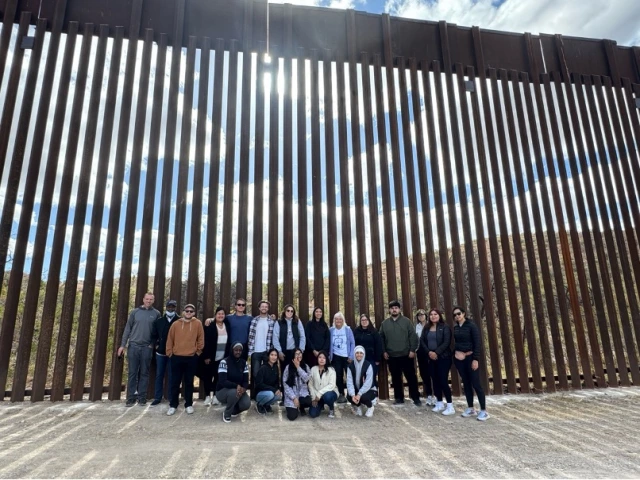
Puentes Mentales
The College of Public Health and binational partners are expanding mental health access for migrants displaced by violence in Sasabe, now residing in Tucson.

Iskashitaa Community Garden Project
CAPLA and the Iskashitaa Refugee Network partnered to launch a course and long-term collaboration supporting refugee food security and student engagement.
Application opens January 2027
Award Cycle: Annual
Limit on Proposals per PI: An individual may participate as PI once per cycle
Next Due Date: March 22, 2027
Award Period: One year from start date; typically August to August
Applications: Accepted through Arizona Cultivate
Description:
The Peter and Pat Hirschman University-Community Research Partnership Fund is designed to support research collaborations with community-based organizations in southern Arizona, including any non-profit and/or non-governmental organizations, and governmental and/or quasi-governmental sectors, with the purpose of advancing both understandings of, and solutions to, social justice-related issues facing the regional community.
Research projects that target initiating or advancing community-based social justice programs must work in collaboration with one or more community-based organizations. As a research partnership program, applications must be made in collaboration with representatives of a regional community or governmental organizations. Applications may also be initiated by a regional community or governmental organization, in collaboration with an eligible University researcher.
Donors’ Intent:
The Donors envision a sustainable program aimed at bringing together the University and community organizations to better understand and address social justice gaps or needs in the region. The Donors wish to prioritize collaborations that hold promise for sustainability among the collaborators. The ultimate goal is understanding a need and developing a sustainable program to meet the identified social justice gap or need.
The Donors understand the term “social justice programs” to be meant in a very broad sense. In the world during which this Fund is established, the meaning would cover such issues as immigration and asylum, housing, civil rights, health issues and healthcare, criminal justice, voting rights, poverty, employment opportunity and advancement including meaningful and justly compensated employment, and educational opportunities, including training and retraining. The Donors know that this list will change over time as new threats to social justice emerge and older problems wane.
The Donors intend that first preference in selection of projects be given to collaborative projects related to immigrants, refugees, asylees, or asylum seekers. Secondarily, preference should be given to applications that demonstrate scalability and expanded impact, and that hold promise in: (a) identifying solutions that can be creatively adapted for deployment in other communities, and (b) resulting in additional grant application from other sources, so as to expand the impact of the Fund.
Award:
The maximum award amount is $21,500 and may be used for items outlined in the Budget Preparation section of the Proposal Preparation Guide v10 (PPG). Funds cannot directly pass to the partner, however they can support the partnership in many ways including, honoraria, participant stipends, workshops, catering, and travel.
Eligibility:
Single investigators, in addition to the eligibility described in the PPG, must have a community partner. University faculty, PhD candidates, and post-doctoral fellows are eligible. Proposal preparation, submission, and processing information are available in the Proposal Preparation Guide v10 (PPG), which is downloadable HERE and is accessible in the Arizona Cultivate competition platform. The PPG includes requirements for the project narrative, the budget, and supplemental documents; interested applicants are strongly encouraged to read the PPG in full as proposals that do not match the PPG will be returned without review.
Selection Criteria:
Awards are intended to support practice-research projects that target initiating or advancing community-based social justice programs, that are in collaboration with one or more community-based organizations, and that will provide a sustainable program of benefit to the members of the partner organization(s). Competitive proposals will:
State the problem or issue that the community faces and what is needed to know to solve the problem, including:
The anticipated sustainable program(s) that will benefit the community
The timeliness and relevance of the program(s) show an understanding of needs, opportunities, and gaps existing in the community
A commitment to shared decision making as to the methods, solutions, and impact between U of A researchers and community partners
Describe how the research methodologies are ethical and feasible and co-created with community partners. Methods must include:
Tangible milestones and/or measures of success and impact
Explanation of the appropriateness of the methodologies
Include a statement of anticipated impact from the partner organization that:
Demonstrates scalability
Identifies solutions that can be adapted by other communities
Results in additional grant applications from other sources, so as to expand the impact of the Fund
Suggestions for Hirschman Fund Proposals
We strongly encourage applications with proposals that:
Address issues surrounding border justice and/or other issues specific to the Southwest, such as immigration and asylum, housing, civil rights, health issues and healthcare, criminal justice, voting rights, poverty; employment opportunity and advancement, including meaningful and justly compensated employment; and educational opportunities, including training and retraining
Align with the University of Arizona’s Hispanic Serving Institution and Land Grant designations and contribute to improving the lives of the individuals, families, and communities within the region
Demonstrate the understanding and practice of ‘servingness’ as referenced within the university’s Hispanic Serving Institution designation
Include leadership development components and address social justice by developing BIPOC leadership
Offer an educational dimension and involve undergraduate or graduate students at the University of Arizona
How Proposals Will be Evaluated
Applications will be evaluated based on:
Alignment with donor intent
Community involvement
Research merit
Proposed feasibility of methodologies and achievability of results
Potential community impact and sustainability of programs
Thoroughness of responses in relation to the selection criteria
Recommended Campus Contacts and Offices who may provide consultation on building and maintaining partnerships:
- Cooperative Extension Offices
- Federally Recognized Tribes Extension Program (FRTEP)
- Hispanic Serving Institution Initiatives
- Native American Advancement, Initiatives & Research
- Native People Technical Assistance Office (NPTAO)
- Office of Societal Impact
- U of A Cooperative Extension Tribal Extension Staff
Questions about the Application Requirements or Arizona Cultivate: Cara Graham